
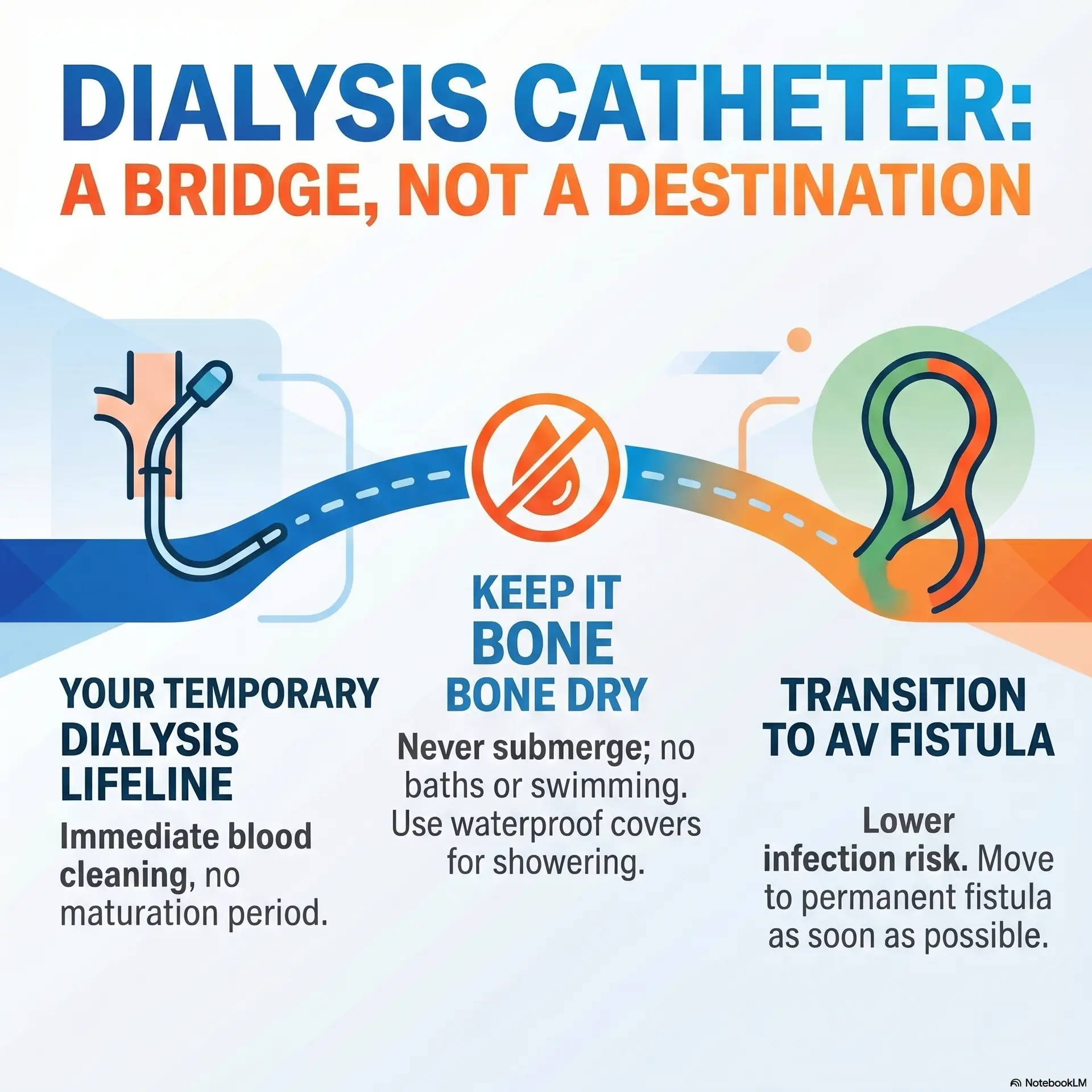
“A tunnelled catheter should be a bridge, not a destination. Understanding it helps you take the next step with confidence.”
Written by Dr Rahul Agarwal, Consultant Vascular & Endovascular Surgeon
CARE Hospitals, Banjara Hills, Hyderabad
Introduction
When a patient needs to start dialysis urgently, or when an AV fistula is not yet ready, a dialysis catheter becomes the lifeline. Understanding what a catheter is, why it is used, and how to care for it can make a significant difference to your safety and comfort.
This guide covers everything you need to know about dialysis catheters — from types and placement to daily care and when to seek help.
What Is a Dialysis Catheter? 🪡
A dialysis catheter is a soft plastic tube inserted into a large vein in the neck, chest, or groin to allow blood to be removed, cleaned by the dialysis machine, and returned to the body. Unlike an AV fistula, a catheter does not require a maturation period — it can be used immediately after insertion.
To understand how catheters compare to fistulas and grafts, read our guide on Dialysis Access Options Explained: AV Fistula, Graft and Central Line.
Types of Dialysis Catheters 📌
Temporary (Non-Tunnelled) Catheters
These are inserted directly into the vein and sit close to the skin surface. They are used for urgent, short-term dialysis — typically a few days to a few weeks. They carry a higher infection risk and are not suitable for long-term use.
Tunnelled (Permanent) Catheters
These are placed under the skin through a small tunnel before entering the vein. A small cuff under the skin helps hold the catheter in place and reduces infection risk. Tunnelled catheters are designed for weeks to months of use, most commonly while waiting for an AV fistula to mature.
⚠️ Even a tunnelled catheter carries significantly higher infection and clotting risks compared to an AV fistula. Your care team’s goal is always to transition you to a fistula as soon as possible.
Where Is a Catheter Placed? 🫀
The most common sites for dialysis catheter insertion are:
- Internal jugular vein (neck) — the preferred site for tunnelled catheters
- Subclavian vein (collarbone area) — used when the jugular is not suitable
- Femoral vein (groin) — used for temporary access only; higher infection risk
Daily Catheter Care 🧹
Proper daily care is critical to prevent infection and keep your catheter working well. Your dialysis team will train you, but here are the key principles:
- Keep the exit site clean and dry at all times
- Never submerge the catheter in water (no baths or swimming)
- Cover the dressing when showering
- Do not disconnect the catheter yourself
- Attend all scheduled dressing changes at the dialysis unit
- Report any redness, swelling, or discharge immediately
Warning Signs You Should Not Ignore ⚠️
- Fever, chills, or shivering — especially if it comes on suddenly
- Redness, warmth, or pus around the catheter exit site
- The catheter appears to have moved or is partially out
- Difficulty or resistance during dialysis blood flow
- Swelling of the arm, neck, or face on the catheter side
When to See a Vascular Surgeon 🧑🏻⚕️
A vascular surgeon should be consulted if your catheter is no longer functioning, if you have recurrent infections, or if it is time to plan for a permanent access like an AV fistula. Early planning prevents the need for emergency catheter insertions. Learn more about permanent dialysis access options at our Dialysis Access & AV Fistula Surgery in Hyderabad page.
Frequently Asked Questions 🙋🏻♂️
Can I shower with a dialysis catheter?
Yes, but you must keep the exit site and dressing completely dry. Use a waterproof cover or wrap the area carefully before showering. Bathing or swimming is not permitted.
How long can I use a tunnelled catheter?
Tunnelled catheters can function for months, but the goal is always to transition to an AV fistula as soon as possible. Long-term catheter use increases the risk of infection, clotting, and vein damage.
What happens if my catheter gets infected?
Catheter infections can become serious very quickly. You will typically need antibiotics, and the catheter may need to be removed and replaced. Seek care immediately if you develop a fever.
Is catheter dialysis as effective as fistula dialysis?
Catheters generally provide lower blood flow rates than a well-functioning AV fistula, which can affect dialysis adequacy. This is one of many reasons why transitioning to a fistula is recommended whenever possible.
Key Insights 🔑
A catheter saves lives in an emergency — but an AV fistula protects your life in the long run. Work with your vascular surgeon to plan the transition as early as possible.
Every day you keep your catheter clean and dry is a day you protect yourself from infection. Consistency in care is everything.
📖 Related Reading:
- Dialysis Access Options Explained: AV Fistula, Graft and Central Line
- AV Fistula Care: Daily Tips to Keep Your Dialysis Lifeline Healthy
- Dialysis Access & AV Fistula Surgery in Hyderabad
About the Author 🧑🏻⚕️
Dr Rahul Agarwal is a Consultant Vascular & Endovascular Surgeon at CARE Hospitals, Banjara Hills, Hyderabad, specializing in AV Fistula surgery, peripheral artery disease, varicose veins, dialysis access, and limb salvage.
Book a Consultation
If you or a loved one needs guidance on dialysis catheter care or planning permanent access, consult Dr Rahul Agarwal.


